
BUILDING SECTOR
The Problem
Construction is one of the largest industries in the world — yet most buildings are still developed as one-off prototypes.
For nearly every project, design, engineering and supply chains are reinvented from scratch.
This leads to fragmented processes, long planning cycles, cost uncertainty and significant waste of time, money and material.
While industries such as automotive, aerospace or electronics rely on system architectures and product platforms, buildings are still typically conceived as isolated projects.
As a result, innovation is difficult to scale, circular material flows are hard to establish and construction productivity has remained largely stagnant for decades compared to other industries.
Structural challenges of the building sector
Fragmented production
Each project requires new planning, coordination and technical solutions. This results in slow planning processes, fragmented supply chains and significant uncertainty regarding costs and timelines.
Limited adaptability
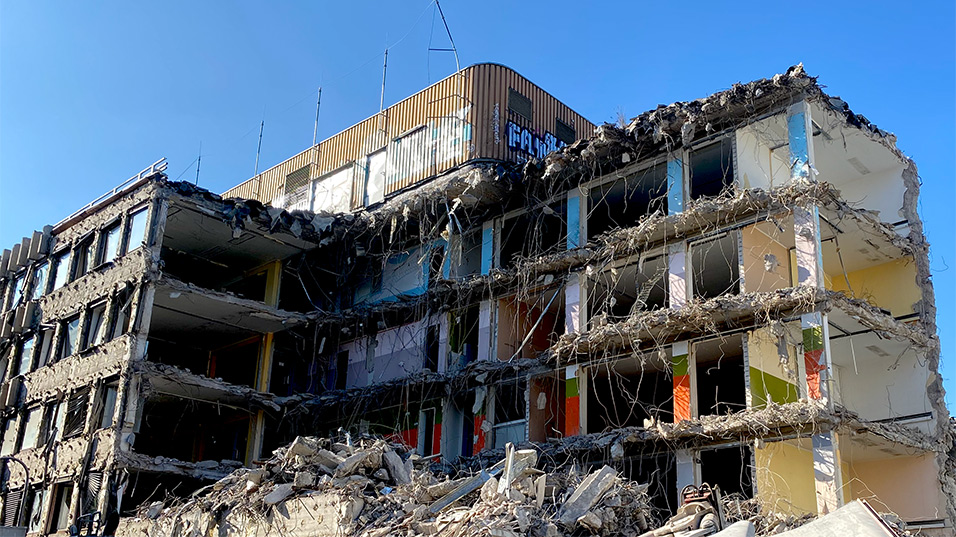
Most buildings are designed for a single purpose and moment in time. When needs change, buildings are often demolished and rebuilt instead of adapted — leading to the loss of materials, embodied energy and asset value. Buildings who loose their function over time, often turn into stranded assets.
Linear material use
Construction consumes enormous amounts of resources. Most building materials are permanently bonded together, making reuse difficult and resulting in large volumes of construction waste.
The underlying issue
Buildings are still treated as isolated projects rather than configurable systems.
As long as this logic persists, productivity gains, circular material flows and scalable innovation remain difficult to achieve.
